
World Sailing Official Case Book
Case 15
In tacking to round a mark, a boat clear ahead must comply with rule 13; a boat clear astern is entitled to hold her course and thereby prevent the other from tacking.
Facts
A and B are approaching the windward mark which they are required to leave to port. They are close-hauled on parallel courses with A clear ahead. A expects B, when she can tack and fetch the mark, to tack to round it and head for the next mark. Instead, B holds her course as shown in the diagram and sails on well past the mark.
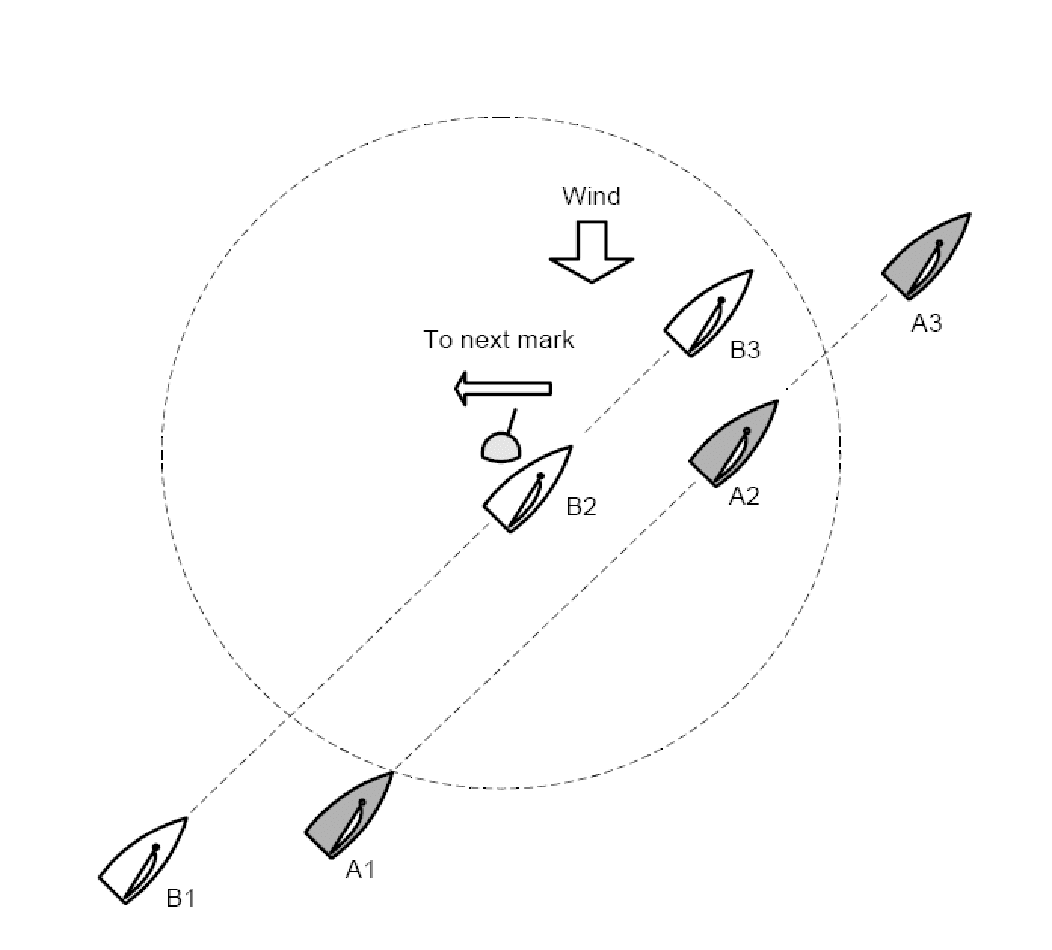
Question
Has B the right to hold her course in this way and, thereby, prevent A from tacking?
Answer
Yes. While A remains on port tack, B is required to keep clear by rule 12 and, as A was clear ahead when she reached the zone, B is required by rule 18.2(a)(2) to give A mark-room as well. Provided B keeps clear of A and gives A mark-room if A luffs (even if A luffs as high as head to wind), B is entitled to sail any course she chooses, including holding her course. However, B is no longer required to give A mark-room after A leaves the zone (see rule 18.2(b)).
If A were to pass head to wind, then at that moment rule 18.2(a) would no longer apply (see rule 18.2(b)), and all other parts of rule 18 would cease to apply because the boats would be on opposite tacks on a beat to windward (see rule 18.1(a)(1) and Case 132). In addition, A would no longer have right of way under rule 12, and B would become the right-of-way boat under rule 13.