
World Sailing Official Case Book
Case 52
Rule 16.1 does not restrict the course of a keep-clear boat. Manoeuvering to drive another boat away from the starting line does not necessarily break this rule.
Facts
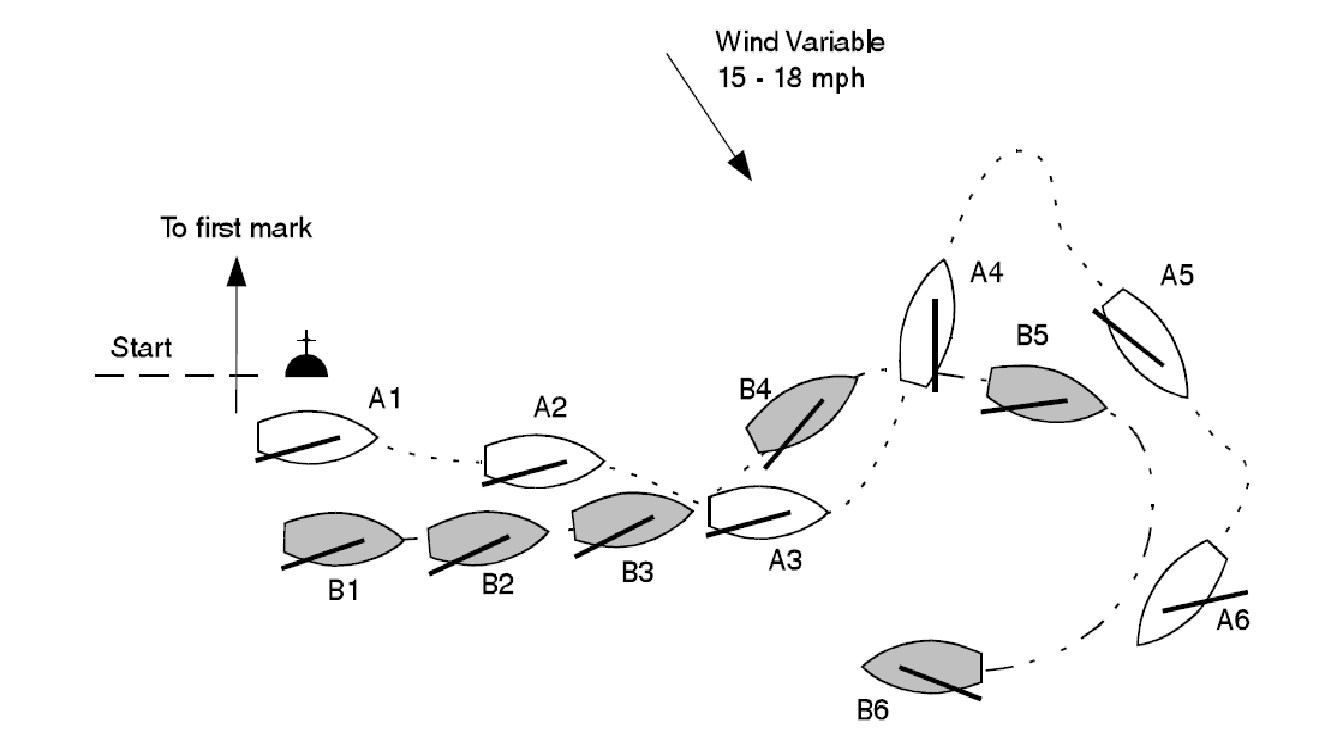
Before the starting signal, two boats, A and B, reached away from the starting line. A, moving faster, passed and was clear ahead of B at position 3. At position 4, A luffed up to close-hauled, intending to tack back to the line, but she found that B also had luffed to a position where, had A tacked, there would have been an immediate collision. A then bore away to gybe, only to discover that B had borne away into a position where a gybe would again cause collision. Finally, B gybed and headed for the starting line, leaving A well astern.
A protested B under rule 16.1, claiming that she had been interfered with while in the act of keeping clear. The protest committee disqualified B, who appealed, holding that her disputed manoeuvres were legitimate means of driving a competitor away from the starting line.
Decision
B’s appeal is upheld. She is reinstated. B’s actions describe a classic manoeuvre in match and team racing, used to gain a favourable starting position relative to another competitor. The essential point is that rule 16.1 applies only to a right-of-way boat, which B, at positions 3 and 4, was not.
At position 4, B, as windward boat, had to keep clear under rule 11, but A could not tack without breaking rule 13. At position 5, B became the leeward boat with right of way under rule 11. Had A gybed onto starboard tack, A would have been subject to rule 15 and, if she changed course after she was on starboard tack, to rule 16.1. The facts show that neither boat broke any rule.