
World Sailing Official Case Book
Case 30
A boat clear astern that is required to keep clear but collides with the boat clear ahead breaks the right-of-way rule that was applicable before the collision occurred. A boat that loses right of way by unintentionally changing tack is nevertheless required to keep clear.
Facts
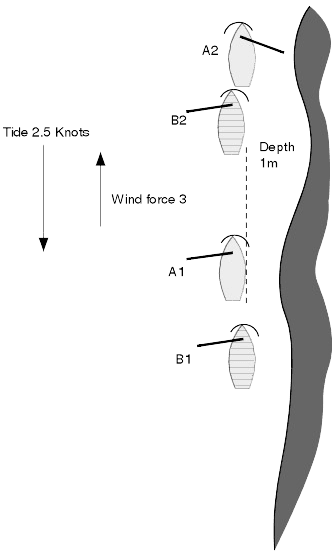
Boats A and B were running on starboard tack close to the shore against a strong ebb tide in a Force 3 breeze. At position 1, A was not more than half a hull length clear ahead of B. B blanketed A, causing A to slow and, at position 2, to gybe unintentionally. This was immediately followed by a collision, although without damage or injury, and B protested A under rule 10. The facts were agreed, and both boats were disqualified: B under rule 12 because, just before A gybed, B was too close to A to be keeping clear, and A under rule 10 for failing to keep clear of a starboard-tack boat.
A appealed on the grounds that she was compelled by B’s action to break rule 10. The protest committee, commenting on the appeal, stated that B caused both A’s gybe and the collision by not keeping clear when both boats were on the same tack.
Decision
The boats were passing close to the shoreline, which was an obstruction and also a continuing obstruction. Therefore, the conditions for rule 19 to apply were met. However, because the boats were not overlapped, neither of the two parts of rule 19 that place an obligation on a boat (rules 19.2(b) and 19.2(c)) applied.
When B was clear astern of A she was required by rule 12 to keep clear but failed to do so. Her breach occurred before the collision, at the moment when A first needed ‘to take avoiding action’ (see the definition Keep Clear).
When B collided with A she also broke rule 14(a). However, at that time she held right of way under rule 10, and, because there was no damage or injury, she was exonerated by rule 43.1(c) for that breach.
After gybing, A became the keep-clear boat under rule 10, even though she had not intended to gybe. She broke that rule, but only because B’s breach of rule 12 made it impossible for A to keep clear. A did not break rule 14(a) because it was not ‘reasonably possible’ for her to avoid contact.
Accordingly, B was properly disqualified by the protest committee under rule 12. However, A is exonerated by rule 43.1(a) for breaking rule 10. A’s appeal is upheld, and she is to be reinstated.