
World Sailing Official Case Book
Case 28
When one boat breaks a rule and, as a result, causes another to touch a mark, the other boat is exonerated. The fact that a starting mark has moved, for whatever reason, does not relieve a boat of her obligation to start. A race committee may abandon under rule 32.1(c) only when the change in the mark’s position has directly affected the safety or fairness of the competition.
Facts
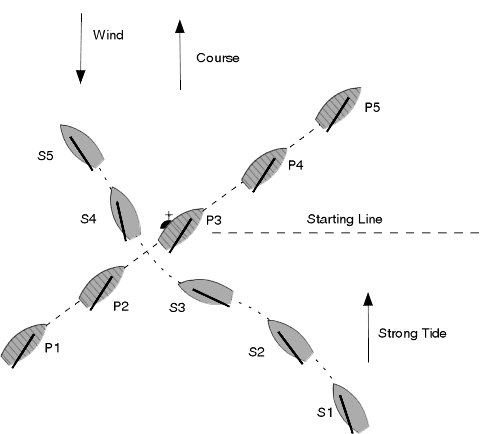
As S and P, close-hauled, approached the port end of the starting line, a strong tide was setting them towards the line and the starting line mark. When S was two hull lengths from the mark, she hailed P to keep clear. There was no response, and S was forced to bear away to avoid a collision. Immediately after the starting signal, P sailed over the mark. As S luffed back to close-hauled, on a course to the wrong side of the mark, it jumped out from under P’s hull and bounced against S. P did not take a penalty, and S did not return to start between the starting marks.
S protested P under rules 10 and 31, and also requested redress, asking that the race be abandoned, citing rule 32.1(c). The protest committee disqualified P for breaking rules 10 and 31, refused S’s request for redress, and scored S DNS. The latter decision was referred to the national authority for confirmation or correction, along with a question: If S had returned to start as required by rule 28.1, could the race have been abandoned under rule 32.1(c) because of the mark having moved?
Decision
Although S touched the mark, she could not be expected to anticipate how it would move when another boat touched it. Therefore S was exonerated by rule 43.1(a) for breaking rule 31 because it was P’s two breaches that caused the mark to touch S. However, S could have returned and started as required by rule 28.1. The fact that the starting mark moved does not relieve her of her obligation to start.
Because S did not start, the race committee was correct in scoring her DNS (see rule A5.1).
Rule 32.1(d) makes it clear that the most important criterion for abandoning a race is that, for some reason, the safety or fairness of the competition has been adversely affected. Rules 32.1(a), (b) and (c) give examples of reasons that may justify abandoning a race; rule 32.1(d) implies that there may be other reasons. In this case, the unexpected movement of the starting mark as a result of P sailing over it did not justify abandoning the race. Indeed, the exact position of a mark frequently and routinely changes as a result of wind, current, waves or it having been touched by a boat, even though its anchor does not move. Such movement is a risk that competitors must accept and does not justify abandoning a race.