
World Sailing Official Case Book
Case 12
In determining the right of an inside boat to mark-room under rule 18.2(a)(1), it is irrelevant that boats are on widely differing courses, provided that an overlap exists when the first of them reaches the zone.
Facts
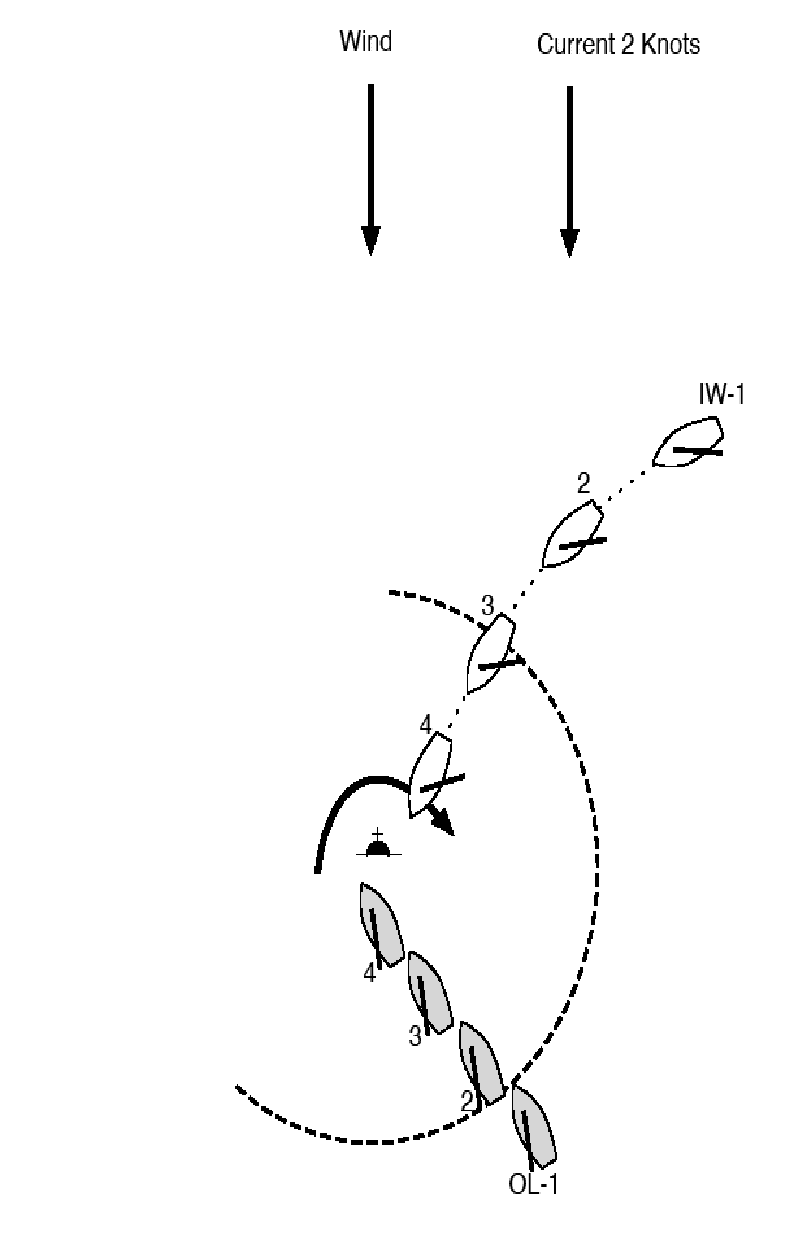
OL and IW were approaching a mark to be left to starboard. The wind was light and there was a 2-knot current in the same direction as the wind. IW, which had sailed high on the course to the mark to offset the effect of the current, approached it with the current, almost on a run. OL, on the other hand, had been set to leeward and, at position 1, about three hull lengths from the mark, was sailing close-hauled slowly against the current. IW twice hailed for water, and OL twice replied, ‘You can’t come in here.’ At the last moment, shortly after position 4 in the diagram, as IW luffed to begin her passing manoeuvre OL tried to give her room, but the two dinghies made contact. There was no damage or injury.
OL protested under rule 11 but was herself disqualified under rule 18.2(a)(1). She appealed, asserting that it was illogical and beyond the intention of the definition Clear Astern and Clear Ahead; Overlap and of rule 18 to consider as overlapped two boats whose headings differed by 90 degrees. She also asserted that the purpose of rule 18 was to protect a boat in danger of hitting the mark that was unable to go astern of the outside boat. She further argued that throughout IW’s approach to the mark until she finally luffed, she was easily able to pass astern of OL, and that IW was not an ‘inside’ boat until a moment before contact.
Decision
OL’s appeal is dismissed and her disqualification is confirmed.
The boats were required to leave the mark on the same side and were on the same tack, and so rule 18 applied after position 1 when OL reached the zone. From that time until contact occurred, neither boat was clear astern of the other and so they were overlapped (see the definition Clear Astern and Clear Ahead; Overlap). Therefore, the first sentence of rule 18.2(a)(1) applied, limiting the rights of OL, the outside boat, under rule 11 by requiring her to give IW, the inside boat, mark-room. OL did not give IW mark-room, and so OL is disqualified under 18.2(a)(1).
IW broke rule 11, but did so while sailing within the mark-room to which she was entitled, and therefore was exonerated by rule 43.1(b).
Both boats broke rule 14(a) because each of them could have avoided the contact. However, because OL was the right-of-way boat and IW was entitled to mark-room, and there was no damage or injury, both were exonerated by rule 43.1(c) for breaking rule 14.
Case 150 discusses issues regarding the definition Overlap and the right to room at an obstruction.