
World Sailing Official Case Book
Case 105
When two boats are running on opposite tacks, the starboard-tack boat may change course provided she gives the port-tack boat room to keep clear.
Facts
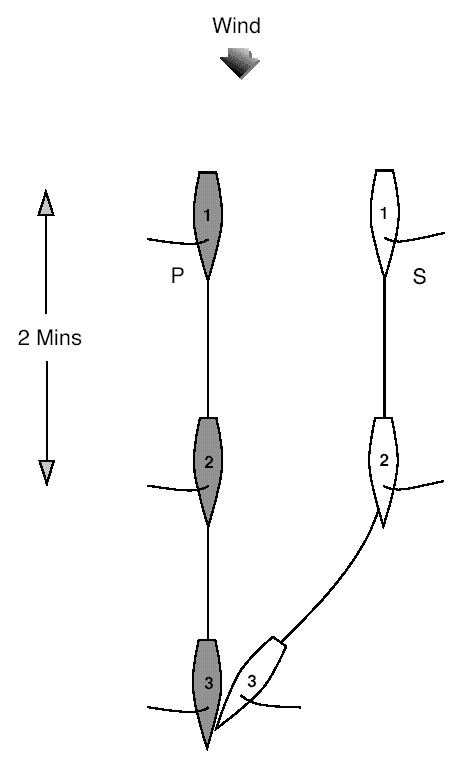
After sailing alongside P for some time on port tack, S gybes to starboard tack without breaking rule 15. Both boats continue to sail parallel courses. About two minutes after her gybe S begins to luff. P does not respond to the luff and the boats touch at position 3. There is no damage or injury.
Question
Answer
S as the starboard-tack boat has right of way under rule 10, and P as the port-tack boat must keep clear. Rule 15 applies only briefly after S becomes the right-of-way boat, but rule 16.1 continues to limit how S may change course. S may luff provided that she does so in a way that gives P room to keep clear, and P must be prepared to react promptly, if necessary by gybing, to continue to keep clear. Since P has room to keep clear of S by responding promptly when S luffs, S does not break rule 16.1. P does not keep clear and does not avoid contact with S. P is therefore penalized for breaking rules 10 and 14(a).
S also breaks rule 14 because, after it becomes clear that P is not keeping clear, S can avoid the contact. However, because there is no damage or injury, she is exonerated by rule 43.1(c).